
Basemark's Latest AR Update Lets One Car Talk Across All of Its Screens
Cars today are increasingly packed with digital displays — a head-up display here, a driver cluster there, an infotainment screen in the middle, maybe a digital mirror on top — and getting augmented reality content to behave consistently across all of them has typically meant building each experience separately. Basemark's newest release of Rocksolid AR Studio is aimed squarely at that problem, adding a handful of features meant to make in-vehicle AR development faster, smarter, and more unified across a car's various screens, while also signaling the company's ambitions to push the same technology well beyond the automotive world.
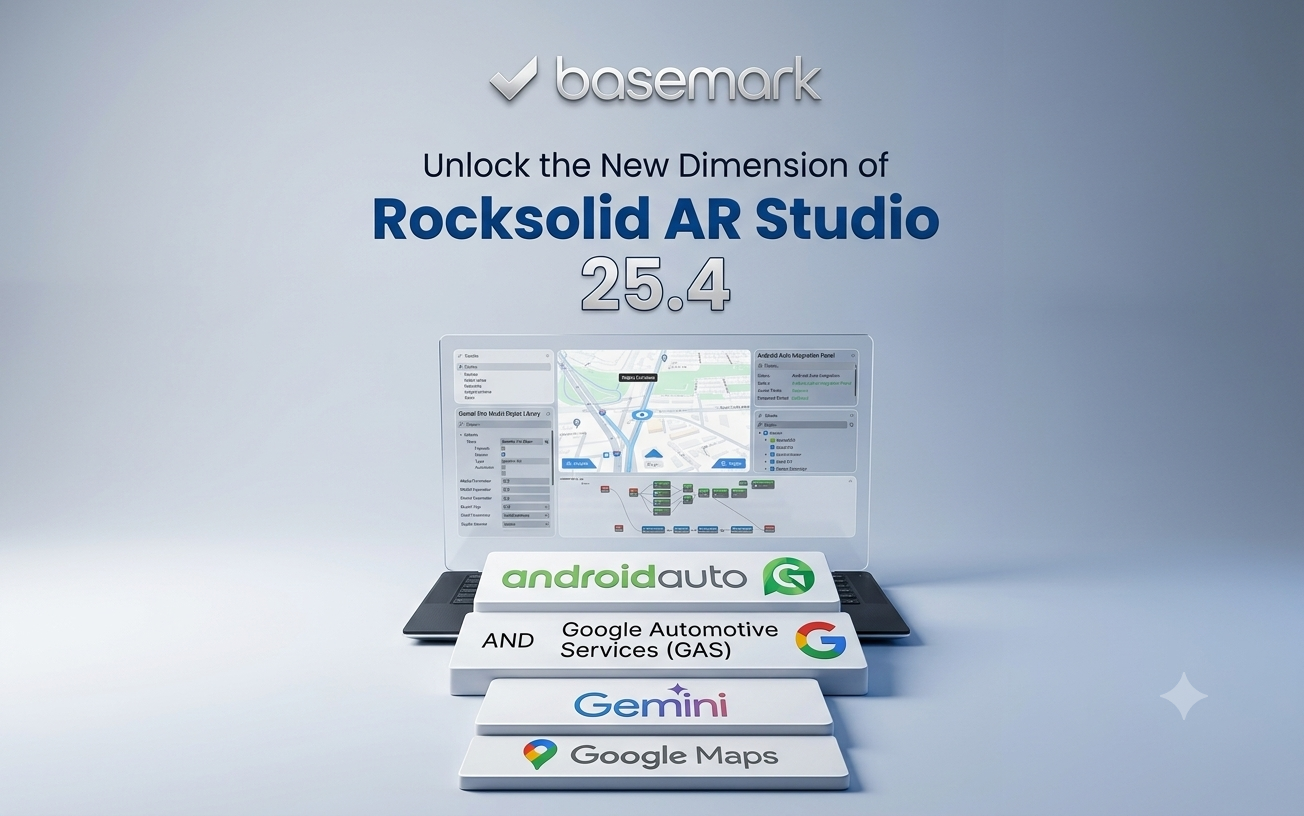
Rocksolid AR Studio is the low-code development tool behind Basemark's broader Rocksolid AR platform, which automotive OEMs use to build things like AR navigation, lane guidance, collision warnings, and other driver-assistance visualizations for HUDs, instrument clusters, and infotainment systems. Version 25.3 folds in a set of prebuilt, plug-and-play integrations for Gemini AI and Google Maps, letting developers add AI assistant features or location-aware functionality without having to build those pieces from the ground up.
The bigger structural change in this release is something Basemark calls Virtual Cockpit, a feature designed to let a single AR experience stretch coherently across multiple in-vehicle displays at once, rather than treating each screen as its own isolated project. That means an AR HUD, a driver cluster, an infotainment display, and even e-mirrors can all be designed, tested, and refined together inside one simulated environment, with real-time simulation letting developers see how everything behaves as a whole before it ships. For developers who need more customization than the low-code tools alone provide, the update also opens the door to writing custom modules directly in C++, built on top of a new Unified API that keeps logic consistent whether it's running inside Studio or in native C++ code. An upgraded scheduling system rounds out the development-side improvements, aiming to keep things running smoothly even when a project involves heavy algorithms or shaky network conditions, and the release adds support for Android 14 under Android Automotive, letting teams build automotive-grade interfaces that tie directly into vehicle data and touchscreen input.
Basemark's founder and CEO, Tero Sarkkinen, framed the release as part of a wider shift for the company, pointing to momentum in automotive AR while also describing plans to bring the same underlying technology to sectors like defense, field operations, and manufacturing, all of which share automotive's need for reliable, mission-critical visual computing. The goal across all of it, in his telling, is the same one that's shaped Rocksolid AR from the start: getting the right information in front of the right person at exactly the moment they need it.