
RayNeo Splits Its Smart Glasses Lineup Into Two Very Different Devices
Most companies making smart glasses right now are chasing the same idea: one pair of glasses that can handle everything from checking notifications to watching movies to snapping photos. RayNeo, the TCL-backed AR glasses maker, is taking the opposite approach with its newest announcement, unveiling two completely separate product lines built for two completely different jobs rather than trying to cram both into a single device. The first is the iO Smart Glasses, aimed at everyday productivity and ambient AI assistance, and the second is the GT Series, made up of the standard GT and the higher-end GT Max, built purely around watching video and gaming on a large virtual screen. Both go on sale September 4, 2026, and RayNeo founder and CEO Howie Li explained the split fairly plainly, saying the company would rather build two dedicated devices tailored to how people actually work and relax than compromise with one device trying to do both.
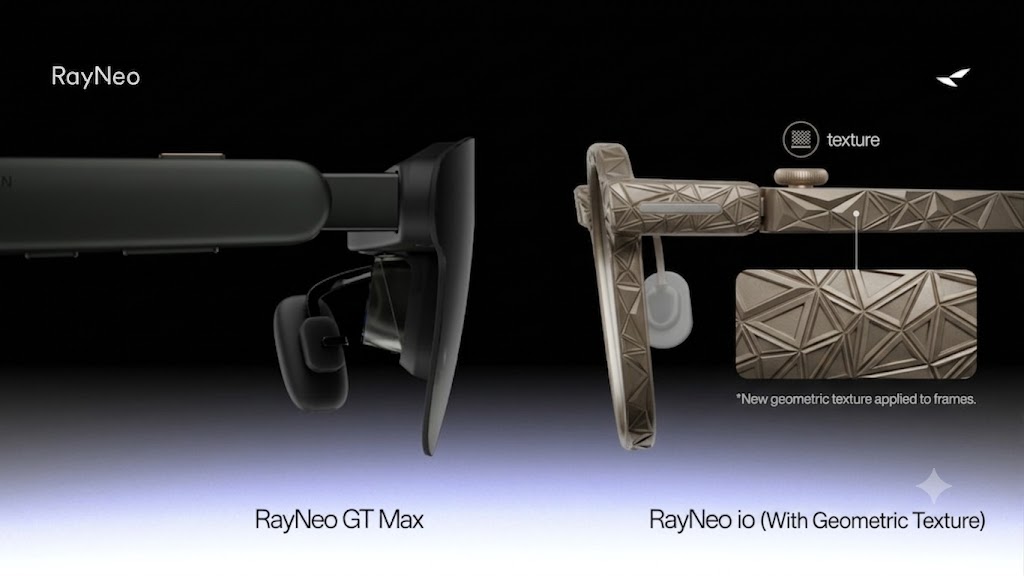
The iO is clearly built for people who want a heads-up display without looking like they're wearing one. At just 33 grams, with the weight balanced evenly between the front and the temples, the frame combines a magnesium-aluminum alloy with titanium temples in a retro round style that RayNeo is calling Crown Panto. The display itself runs on a tiny monochrome green projector RayNeo calls its Firefly Nano Engine, feeding into a waveguide lens the company says is 97% transparent, meaning the text overlay is meant to be visible to the wearer while staying essentially invisible to anyone looking at them from the outside. RayNeo has built what it calls an 'Ambient AI' layer into the glasses as well, a background system that quietly logs schedules and conversation context throughout the day, then automatically pulls out action items after a meeting and lets the wearer confirm calendar updates with nothing more than a nod. On the language side, real-time translation runs through Timekettle's BabelOS engine, reportedly covering 55 languages and over a hundred regional accents with roughly a one-second delay, aided by a four-microphone array and a bone-conduction sensor designed to isolate speech in loud environments instead of relying on a traditional speaker. Core AI features run on RayNeo's own assistant paired with Gemini 3.1 Flash Lite, though a separate tier lets users switch between other major models including ChatGPT, Claude, and DeepSeek if they'd rather not stick with RayNeo's default. A 240mAh battery is rated for around two days of typical use, or a maximum of roughly 18 hours of continuous recording, and the glasses round out with a physical rotating dial on the temple, Bluetooth 5.4 with Apple's MFi certification for iPhone compatibility, and basic dust and splash resistance.
The GT Series takes a completely different approach, dropping the productivity features entirely in favor of acting as a portable, private movie screen. Both the GT and GT Max are built around a dual-chip system, pairing a dedicated display processor with a separate motion-tracking chip so the virtual screen can respond to head movement without lag. The GT Max is the more capable of the two, using a higher-end optical engine and a fifth-generation OLED display panel to produce a 59-degree field of view, with the virtual screen scalable up to the equivalent of a 307-inch display depending on preference. The standard GT uses a simpler optical design with a narrower 46-degree field of view and tops out at a still-sizable 231-inch equivalent screen. Paired with RayNeo's companion streaming device, the Pocket TV Pro, the company claims the GT Series is the first AR glasses system able to natively play Dolby Vision content while also converting standard-dynamic-range video to HDR in real time, which would be a meaningful selling point for anyone using these primarily to watch movies on a plane or during a commute. To keep the picture steady during actual movement, the glasses include three distinct viewing modes: one that filters out shake from things like turbulence or a bumpy train ride, one that pins the virtual screen in a fixed spot in space regardless of head movement, and one that follows the wearer's gaze more naturally. Audio is handled by a Bang & Olufsen-tuned speaker system built into the frame itself, which RayNeo says delivers noticeably stronger bass than typical for open-ear audio along with a head-tracked spatial sound effect and a directional mode meant to keep audio from leaking to people nearby. The GT weighs 68 grams and the GT Max 78 grams, and the GT Max additionally comes in three fitting sizes to better match different interpupillary distances, something the standard GT doesn't offer.
Both product lines will be sold through RayNeo's own website and its Amazon storefront, with the iO available in a dark grey finish called Polar Night and a gold finish called Dune, while both GT models support swappable prescription lens inserts for people who need corrective lenses. RayNeo has not announced pricing for either lineup yet, though that's expected to surface closer to the September 4 launch, and the company plans to show off both product lines in person at IFA 2026 in Berlin, running September 4 through 8.
Splitting the lineup this way puts RayNeo in an interesting competitive spot, effectively fighting on two fronts at once rather than one. The iO lines up more directly against Meta's AI-powered glasses, competing on the ambient-assistant and translation use case rather than displays or media. The GT Series, on the other hand, goes head-to-head with companies like XREAL that have built their business specifically around personal, portable big-screen viewing. Whether splitting the product line actually serves customers better than a single do-everything device remains to be seen, but it's a clear bet that the productivity and entertainment use cases for smart glasses have diverged enough that they're better served by separate hardware rather than one compromise design trying to satisfy both.